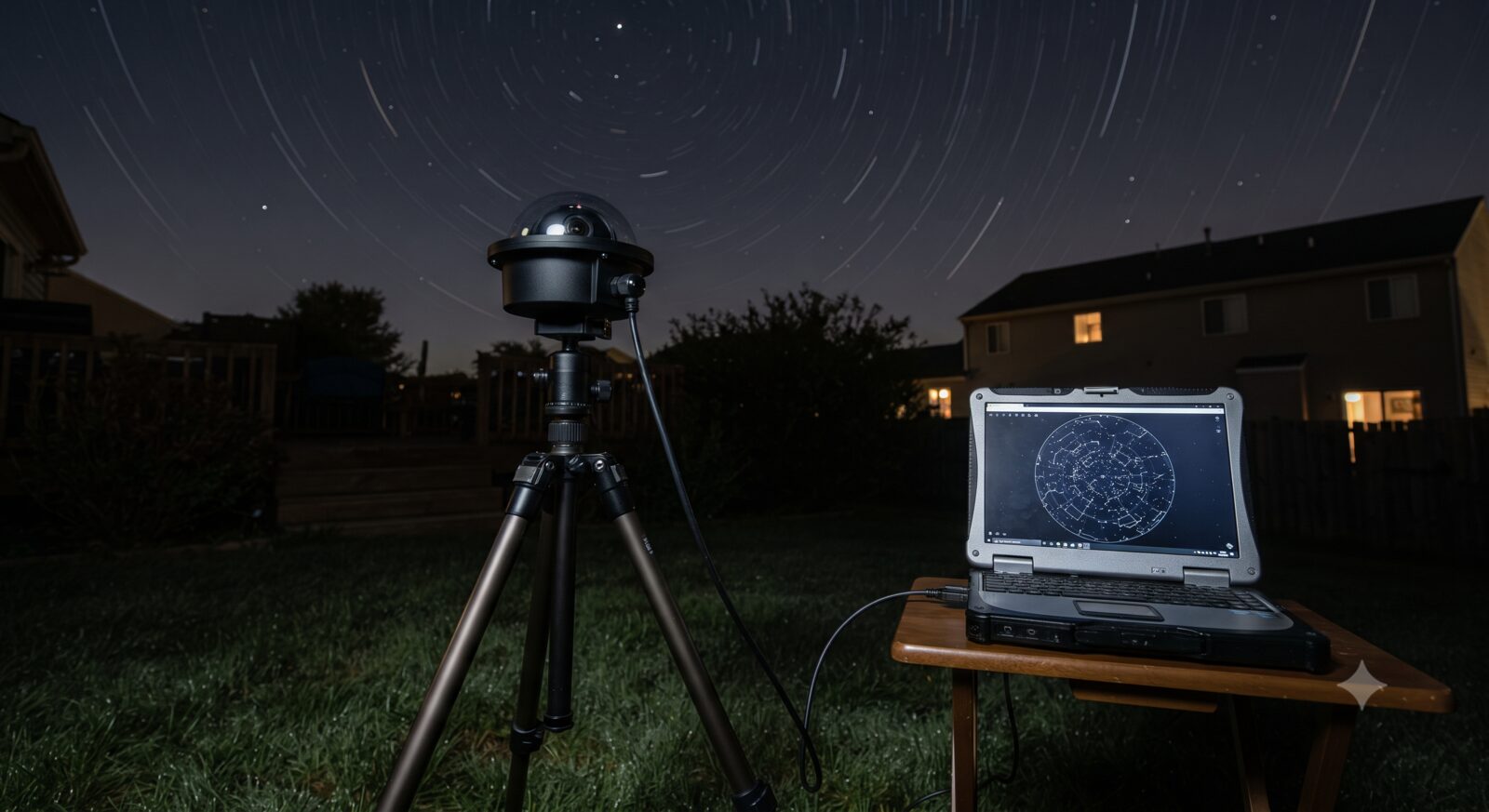
A DIY sky-watch station generates a lot of footage — and most of what it captures won’t be anomalous at all. Satellites, aircraft, weather balloons, birds, drones, and meteors account for the overwhelming majority of anything unusual a camera catches. Connecting your setup to real citizen-science sky-monitoring networks helps with both sides of that problem: ruling out the mundane explanations, and contributing genuinely useful data if something isn’t easily explained.
This page contains an affiliate link. If you make a purchase through it, we may earn a commission at no extra cost to you.
If you’re contributing captures to a network like this, that footage is only useful as long as it still exists — see our guide on protecting sky-watch data and footage, including AOMEI’s backup software, for keeping it that way.
Rule Out the Common Explanations First
- Satellites and the ISS move in smooth, predictable arcs at a constant speed and are visible primarily around dawn and dusk when they still catch sunlight while the ground is dark. Satellite-tracking tools can confirm whether a known object was overhead at the exact time of a sighting.
- Meteors are brief, streak in a straight line, and burn out within a second or two — categorically different from an object that hovers, changes direction, or persists for minutes.
- Aircraft at high altitude can appear as a stationary or slow-moving point of light, particularly at an angle where blinking anti-collision lights are harder to distinguish — flight-tracking data can confirm or rule this out for a specific time and location.
- Drones are increasingly common and can behave in ways that look more anomalous than an aircraft (hovering, sudden direction changes, irregular lighting) — and are exactly the kind of object a DIY ground-level camera is well-positioned to catch clearly enough to identify.
Real Networks Worth Knowing About
Several real, active citizen-science networks already do organized sky monitoring, and a DIY setup can plug into their methodology even without formally joining:
- CAMS (Cameras for Allsky Meteor Surveillance), run through the SETI Institute, uses a distributed network of low-light cameras to triangulate meteor tracks and calculate trajectories — a useful model for how multiple stations can cross-reference the same event.
- Sky360 is a community platform built specifically around observing the sky for the full range of what actually shows up in it — stars, meteors, satellites, aircraft, drones, weather phenomena, birds, and UAP — with an active discussion community for exactly the kind of triage described above.
- AllSkyCams focuses on building out a large citizen-operated fireball camera network using inexpensive, open-source hardware — a genuinely comparable build philosophy to a Raspberry Pi-based sky-watch station.
Why This Actually Matters for Serious Research
NASA’s own 2023 UAP Independent Study Team report explicitly recommended expanding citizen reporting as a way to build a broader, more reliable dataset — not as a lesser substitute for institutional data collection, but as a genuine contribution to it. A single home station generates limited data on its own; a station whose captures get cross-referenced against known-object databases (satellite passes, flight tracking, meteor shower calendars) produces results that are actually usable, rather than a pile of unexplained footage with no way to rule out the ordinary explanations.
Frequently Asked Questions
Do I need to formally join a network to benefit from this?
No — even without joining, using the same triage habits (checking satellite and flight-tracking data, knowing what a meteor actually looks like) will rule out the large majority of what a home station captures.
What percentage of captures typically turn out to be mundane?
There’s no single universal figure, but every organized sky-monitoring effort — civilian and military alike — consistently finds that the overwhelming majority of anomalous-looking captures resolve to a known object once properly cross-checked. Treat an unexplained capture as the rare exception to rule in, not the default assumption.
Is this the same as reporting a sighting to AARO?
No — these are independent citizen-science communities, not an official government reporting channel. They’re complementary: ruling out the mundane explanation is a useful step to take before deciding whether an official report is warranted at all.